

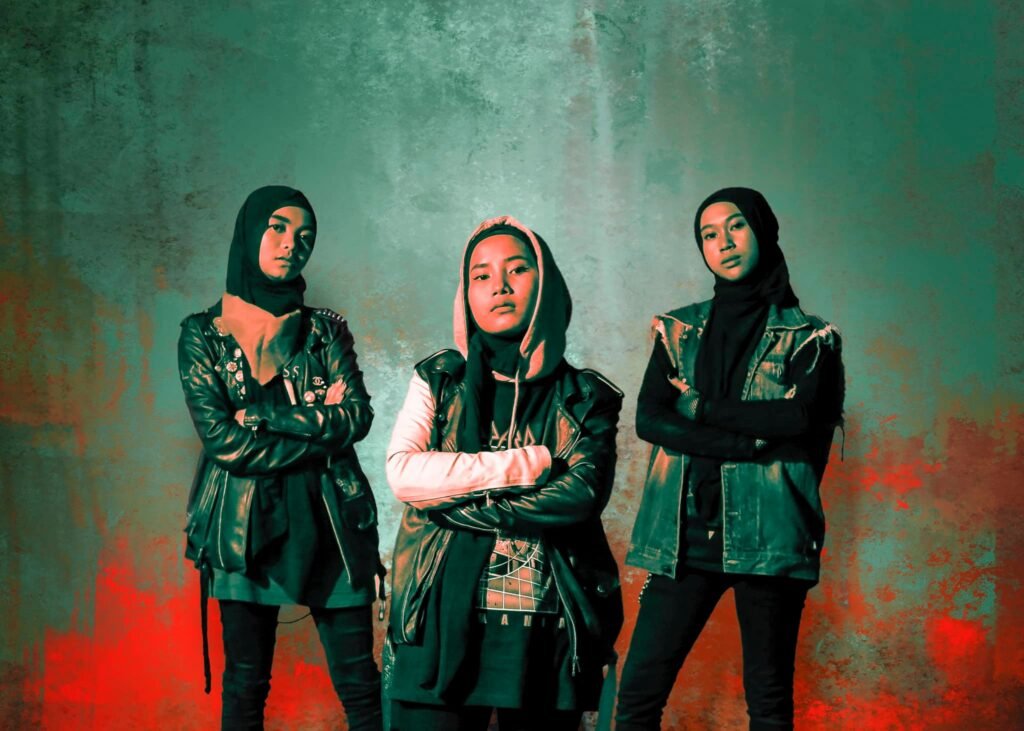
Female-led bands delivering a hard-hitting, direct sound are not uncommon, but one in particular has gained worldwide visibility thanks to its unique profile: Voice of Baceprot.
The trio—Firdda Marsya Kurnia (vocals, guitar), Euis Siti Aisyah (drums), and
Widi Rahmawati (bass)—comes from the small Indonesian town of Garut in West Java. Garut lies about five hours southeast of the capital, Jakarta. The girls, daughters of farmers, grew up in a very particular part of their country. It is a rural, conservative region. They first met while attending the same madrasa, a Muslim high school.
Indonesia is, after all, the country with the largest population of practicing Muslims, and it’s also a place where pluralism and different religions often clash. It’s therefore no surprise that Voice of Baceprot caused a stir among conservative religious circles: it’s not every day you see young women performing such a loud, rebellious genre, and wearing the hijab—the traditional Muslim veil—on stage.
Metal, however, has a strong following in Indonesia, with support even from President Joko Widodo, who has promoted numerous tours and concerts and attended some in person. But these three young women decided to challenge the very religion they practice to pursue their passion fully, proving to the world that every genre of music, including metal, is for everyone.
The message Firdda, Euis, and Widi have sent has had a huge impact both within the Indonesian and international metal communities—not just because of their appeal, but because they are young musicians who have found the courage to assert themselves and scream to the world to look beyond prejudices and stereotypes.
Stylistically, Voice of Baceprot plays alternative metal, sung in both English and Sundanese, with a strong groove-metal component influenced by Lamb of God, Machine Head, and Rage Against the Machine, giving their sound extra punch and cohesion. To date, they have released three singles and a live EP. Despite their growing fanbase, they have faced criticism and threats from religious extremists: blackmail, harassment, and even death threats have been attempts to undermine their success. They are labeled as blasphemous and “not proper” according to what a “good Muslim woman” should be, but their expressions tell a very different story.

How did your passion for heavy metal begin?
“Metal music captivated us from the very beginning. It’s certainly not a genre typically associated with Muslim girls who always wear the hijab, but that’s exactly why we chose to play it—to give ourselves courage and break free from the suppression of various stigmas and prejudices. We believe our voice as independent and free women, and as human beings, can reach a wider audience through music, and every day we strive to expand our ideas further.”
You chose a very distinctive name. What inspired it?
“Our music teacher, Abah Erza, came up with the name. He was the first to encourage us to play music rather than perform in the theater, which we did at first. He coined the name Voice of Baceprot—‘baceprot’ in Sundanese means ‘noisy.’ He said it suited our personalities since we always speak out about what’s happening around us. And our music is indeed quite loud.”
Metal is often censored because the public associates it with the ‘music of the devil.’ How is this genre perceived in Indonesian society?
“Metal is very popular in Indonesia, and we have an extreme scene like few others in Asia, which has grown rapidly. But we’ve also noticed that opposition from certain communities has fueled hostility toward the genre, which is seen as incompatible with Islamic or other religious ideals. The reality is that more people accept it and see metal as a means to spread ideas and release emotions, and we’ve used it for that purpose too.”
Islam is not the only religion in Indonesia, but it is one of the most widespread. In some Muslim-majority countries, just like in some Christian-majority ones, heavy metal is persecuted and sometimes banned by law or religion, especially in the Middle East. As Muslim women, what are your thoughts on the importance of freedom of expression and the freedom to play this music?
“As women who believe in Islam as a religion of peace, we believe freedom of expression is a human right granted by God and must be defended. When we witness acts of violence or suppression, it only motivates us further to continue our music and our fight against authoritarian regimes that don’t allow people to express themselves freely. No other theme has engaged us as deeply as this one.”
You’ve faced many challenges, including death threats, for playing heavy metal. Do you think there will be more tolerance for metal in the future?
“We want to keep hoping that the voice of humanity will be heard and accepted even more in the future, beyond doctrines of hatred.”