Extreme is the way

Les Légions Noires: The Dark Side of France – Part two

Ten musicians, two independent labels, and a single path to follow. This is how the Black Legions forged a unique musical legacy—one steeped in nihilism and misanthropy, ideals that fully reflected their philosophy.

Projects, Artists, and Releases

In 1991, the Black Legions collective officially began its tormented journey. Operating in the shadows, far from the approving gaze of the world, it nevertheless ignited the curiosity of daring listeners. In France at that time, such a dark eruption was entirely unprecedented—anyone craving truly authentic black metal felt a bleak void and could only glance longingly toward Scandinavia. For this reason, particularly on a local level, devotees finally discovered something savage to call their own, and, as rumors crept through the underground, whispers of the group slowly began to surface.
 
The circle revolved around ten musicians, all multi-instrumentalists united by a shared artistic vision: a dark, deep, visceral form of black metal with a harsh, abrasive sound. In short, a raw aesthetic that mirrored the inner world of every member within the collective.
 
The intense collaboration among these artists led to the creation of numerous bands and side-projects, many closely related to one another. Given their sheer number and often short lifespan, detailing each one would be unnecessary. Instead, focusing on the main projects is enough to understand the philosophy of the Black Legions, while also highlighting the key figures who shaped the movement.

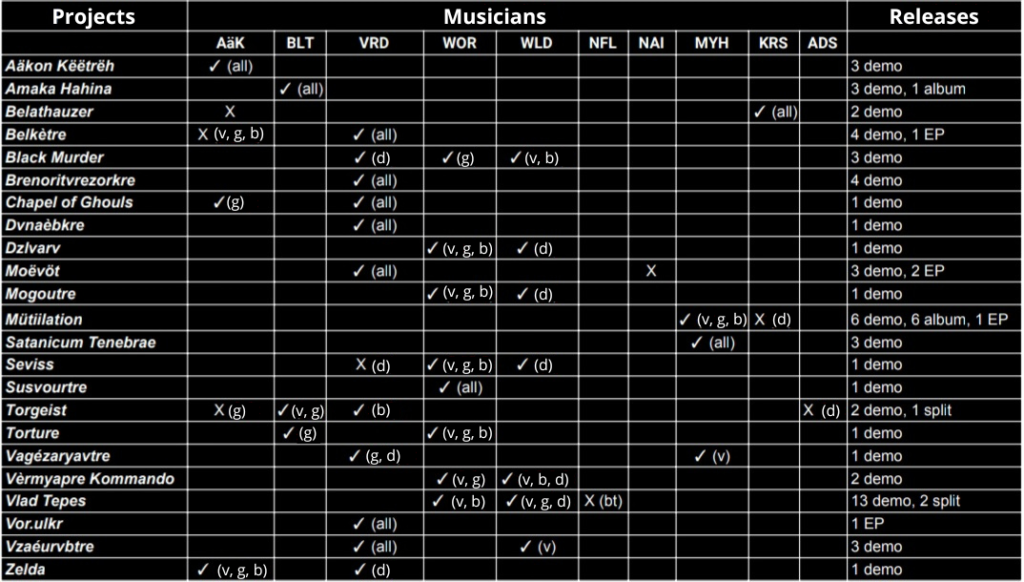
Summary table of the total number of projects, musicians, and releases of the Légions Noires.
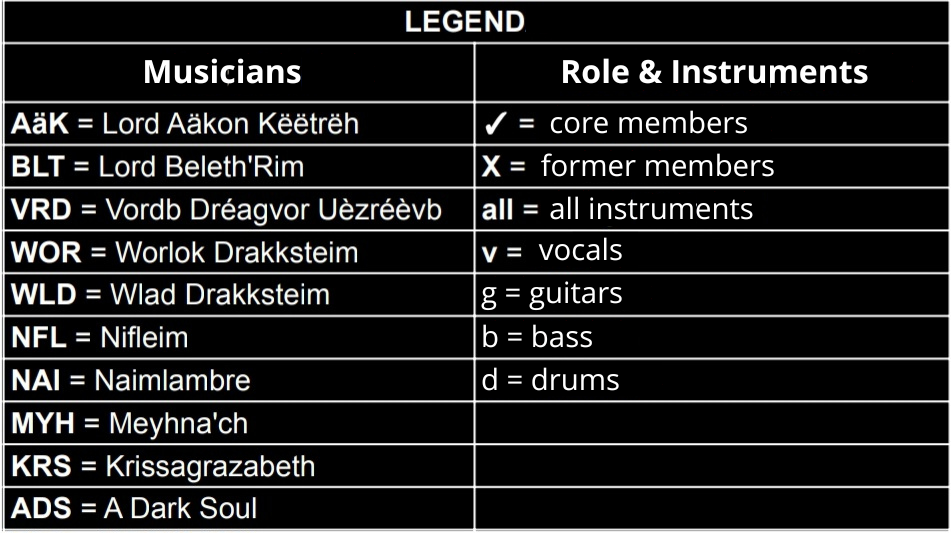
Note: The listed members are the most significant and long-standing. Those who collaborated only briefly will be mentioned within their respective bands.
Among them, the most recognizable name is Mütiilation. The project was formed in 1991 by Meyhna’ch (aka William Roussel) as guitarist and vocalist. David handled bass, and Jean-Luc played drums. Although the latter were only temporary members, they contributed to the band’s first demo, Rites Through the Twilight of Hell (1992), which featured lo-fi production and a dark, chaotic atmosphere.
 
The band continued its path with two more demos in 1993—Satanist Styrken and Ceremony of the Black Cult. Meyhna’ch’s musical style and ideological stance soon caught the attention of the Black Legions, who welcomed him into the fold, where he quickly became a central figure.

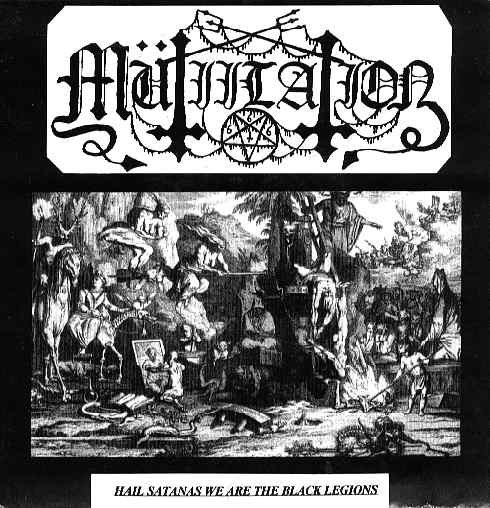
The cover of Hail Satanas We Are the Black Legions
A defining release is the EP Hail Satanas We Are the Black Legions, whose title alone serves as a manifesto. The record encapsulates the collective’s ethos: overtly anti-Christian lyrics, a saturated, abrasive sound, and unrelenting aggression, condensed into three tracks.
 
The environment of the circle proved fertile for Meyhna’ch, who expanded his output with the side-project Satanicum Tenebrae. However, not all members adapted to the evolving group dynamic—Jean-Luc, feeling constrained by these changes, left the group and was subsequently branded a traitor.
 
Following Jean-Luc‘s departure, Meyhna’ch quickly recruited new members: Mørdrëd on bass and Krissagrazabeth (already active in Belathauzer) on drums. With this reshaped lineup, he recorded the landmark full-length Vampires of Black Imperial Blood (1995), alongside another EP, Evil – The Gestalt of Abomination, which was never officially released.
 
Thanks to this milestone, Mütiilation became one of the Black Legions‘ flagship acts, earning the respect of the entire collective—though this peak proved short-lived.

Meyhna’ch
In 1996, Meyhna’ch fell into alcohol and drug abuse, violating the strict codes of the group. This led not only to Mørdrëd’s departure but also to Meyhna’ch’s expulsion from the Black Legions altogether.
 
He subsequently disappeared from the scene, only to re-emerge in 1999 with Remains of a Ruined, Dead, Cursed Soul. This release featured re-recorded material with improved production. From that point on, Mütiilation became a solo project. The style shifted toward a more melodic approach. This can be heard on the EPs New False Prophet (2000) and Destroy Your Life For Satan (2001), followed by the full-length Black Millennium (Grimly Reborn).

Meyhna’ch would vanish again in the early 2000s, with rumors even suggesting his death. However, he unexpectedly returned in 2003 with Majestas Leprosus, once again featuring partially reworked material.
 
By then, the raw sound of early Mütiilation had largely faded. This shift was confirmed by later albums Rattenkönig (2005) and Sorrow Galaxies (2007), the project’s final full-length releases before its definitive end in 2017.
 
Or at least, for what seemed to be its end. In recent times, Meyhna’ch has returned to the scene alongside drummer Kham, recording Black Metal Cult (2024) and Pandemonium of Egregores (2025), keeping the black flame of the Légions Noires alive despite a turbulent past.

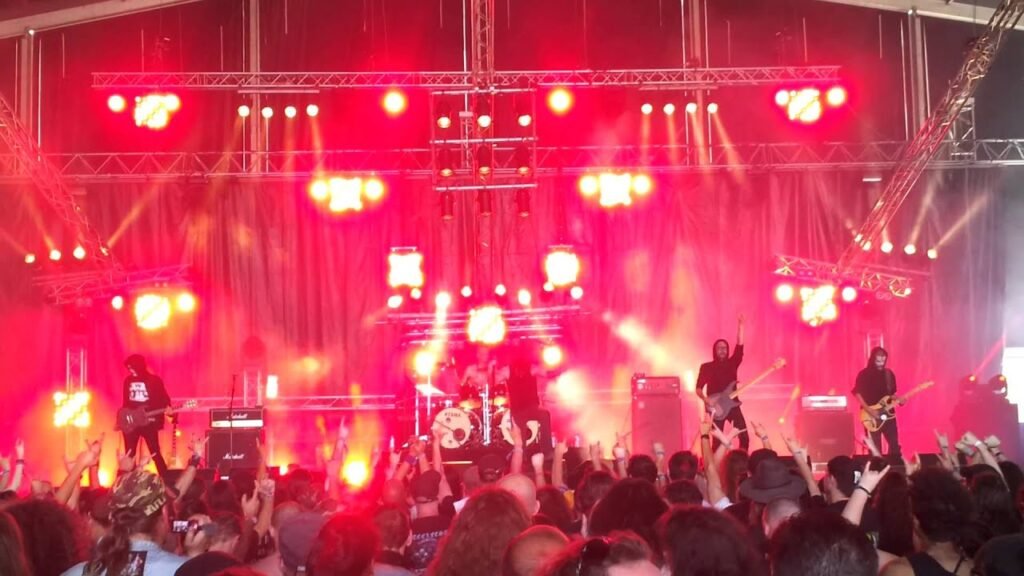
Mütiilation live at Hellfest 2015
Although Mütiilation stands as the most prominent Black Legions name, it is equally important to highlight the collective’s undisputed leader: Vordb Dréagvor Uèzréèvb, whose solo and collaborative influence resonated across most of the group’s projects.
 
One of his most notable acts is Belkètre, formed in 1993 with Lord Aäkon Këëtrëh following the dissolution of earlier collaborations such as Chapel of Ghouls and Zelda. Between 1993 and 1994, the duo released several demos, including Twilight of the Black Holocaust, which was notable for its raw, blasphemous nature.
 
Belkètre’s lifespan was brief, culminating in the 1996 EP Ambre Zuèrkl Vuordhrévarhtre. This nearly 45-minute opus showcased the duo’s full capabilities. The release featured tortured screams, barely listenable drumming, and riffs that seem to emerge from beyond the grave. All these elements were delivered with surprising precision despite the lo-fi production.
 
The project officially ended in 1997. After years of inactivity, Belkètre resurfaced in 2015 with the unexpected EP Ryan Èvn-a, which, despite modern production, diverged from the traditional LLN sound.

Parallel to Belkètre, Vordb and Lord Aäkon Këëtrëh founded Torgeist another main project of the Black Legions. This time as a quartet—with Lord Beleth’Rim on second guitar and A Dark Soul on drums—the band released two key demos: Devoted to Satan (1994) and Time of Sabbath (1995). While similar in essence, the latter displayed a more refined and aggressive approach, driven by relentless, diabolical rhythms.
 
After Torgeist dissolved, its members redirected their focus to other projects. Lord Aäkon Këëtrëh pursued solo work, exploring dark ambient territories through demos such as Journey into the Depths of Night (1995), Dans la forêt… (1996), and The Dark Winter (1997).

Similarly, Lord Beleth’Rim embraced darker atmospheres with his solo project Amaka Hahina, releasing multiple demos and the album Aheah Saergathan!, as well as collaborating on other side-projects.
 
Vordb remained committed to sonic extremity, blending black metal with ritualistic dark ambient sounds and often employing the gloatre language. His projects Brenoritvrezorkre and Dvnaèbkre exemplify this style, while Moëvöt explores more purely ambient territory.
 
Among his collaborations, Vagézaryavtre—created with Meyhna’ch—stands out. Though it produced only a single demo, it highlighted their unique partnership. Numerous other projects further emphasize his central role within the collective.
 

Worlok Drakksteim (on the left) and Wlad Drakksteim (on the right)
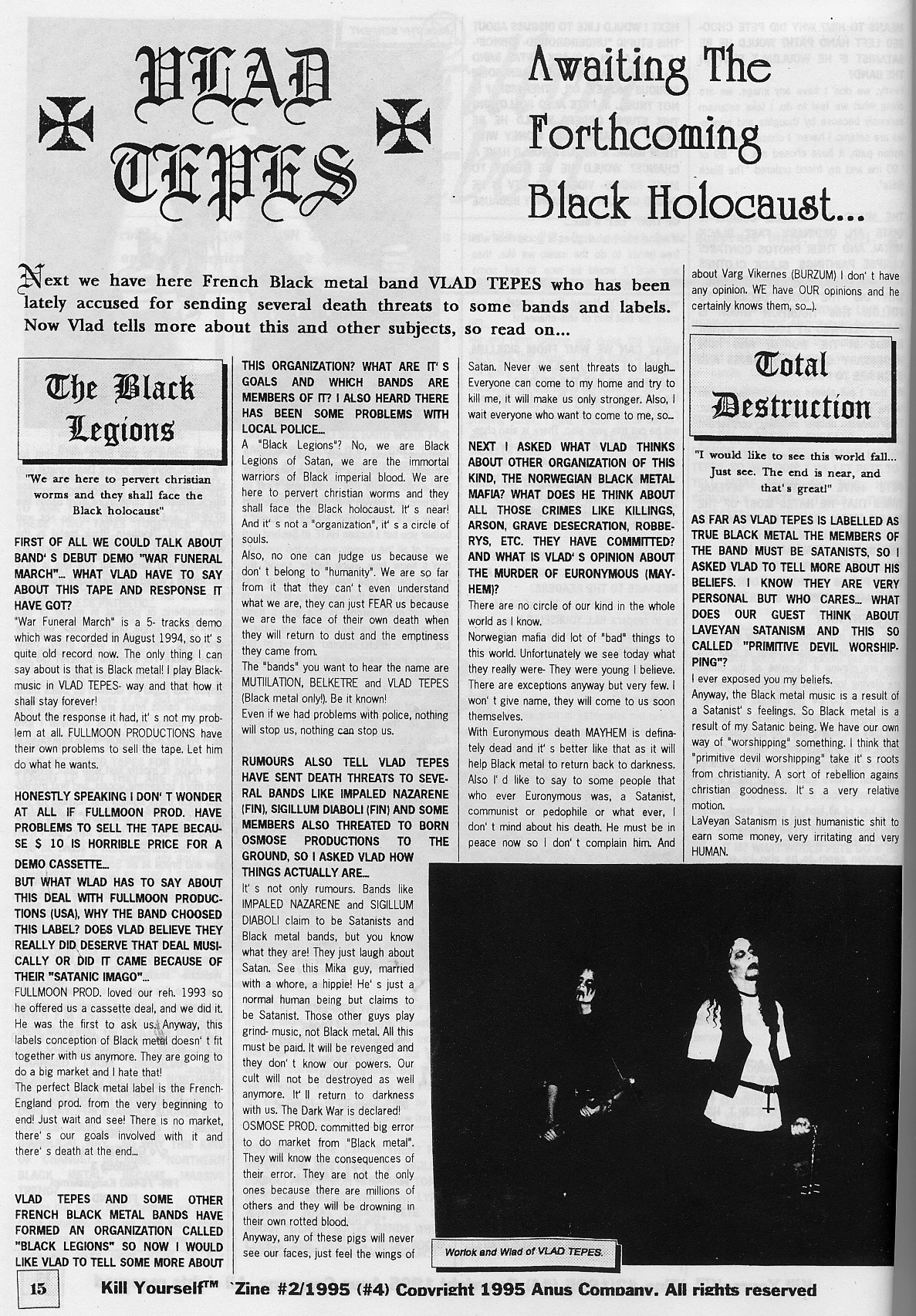
Two other key figures within the Black Legions were Worlok Drakksteim and Wlad Drakksteim. They were known for their unwavering commitment to the group’s ideological core—centered on Satanism, war, and profound misanthropy.
 
Their most significant contribution was Vlad Tepes, one of the most representative projects of the collective. Named after Vlad III of Wallachia—an infamous historical figure who inspired the Dracula myth—the band embodied the darkest aspects of black metal.
 
Between 1993 and 1996, Vlad Tepes released twelve demos, including Winter ’93, War Funeral March (1994), and The Return of the Unweeping (1995). The band also released split albums, including March to the Black Holocaust (with Belkètre) and Black Legions Metal (with Torgeist).
 
Their sound remained true to LLN tradition: anguished atmospheres, abrasive guitars, and extreme vocal delivery.

Like many LLN projects, Vlad Tepes eventually disbanded, leaving behind a legacy of influential recordings.
 
The Drakksteim brothers also participated in other projects such as Dzlvarv, Mogoutre, and Vèrmyapre Kommando, and collaborated with Vordb Dréagvor Uèzréèvb on acts like Black Murder, Seviss, and Vzaéurvbtre.

The End of the Black Legions

The Black Legions, like many underground movements, were not driven by a specific goal beyond expressing their raw music and philosophy. However, their approach was uniquely extreme.
 
Unlike Norway’s Inner Circle—whose members, including Burzum, Euronymous, and Faust, drew infamy through criminal acts and media coverage—the Black Legions maintained deep anonymity.
 
Apart from Meyhna’ch, members never revealed their true identities. This anonymity extended to their entire ethos. Their strict codes—prohibiting drugs, violence, and reckless behavior—ensured they would avoid the notoriety that defined other scenes.
 
Another difference was scale: with just ten members, the Black Legions were far smaller than other national movements, which often included dozens or even hundreds of members. Despite their productivity, most projects lasted less than a decade.

The timeline indicates the duration period of the projects. Belkètre, Moëvöt, and Mütiilation are the only ones that remained active beyond 2002
By 1997, the Black Legions had effectively dissolved, as most of their projects ended. Although the precise reasons remain unclear, it is likely that the group’s fiercely individualistic spirit ultimately prevented long-term cohesion.
 
In a 1995 interview with Kill Yourself Magazine, Wlad Drakksteim succinctly articulated the group’s worldview, dismissing the Norwegian and Finnish scenes as superficial and accusing them of misrepresenting the essence of black metal.
 
For the Black Legions, the genre was a vehicle for expressing hatred, poison, and depression. These forces were meant to reveal the deepest, most destructive aspects of human nature. “Black metal is hatred, poison, depression… it is everything that destroys the human being,” Wlad stated in the interview. He emphasized their complete disinterest in the outside world.
 
This radical perspective may well have contributed to their end; after all, sustaining a musical movement without seeking an audience is inherently paradoxical. For the Black Legions, music served as a means of deep internal expression, confined to the boundaries of their own circle, never about recognition.

The cover of March to the Black Holocaust with LLN's logo
Today, only speculation surrounds their disbandment. What remains certain, however, is that the Black Legions were a cohesive and well-defined entity that left a mark during the formative years of black metal.
 
Although France would later produce bands such as Seigneur Voland, Blessed in Sin, Osculum Infame, Sacrificia Mortuorum, Peste Noire, and Deathspell Omega—solidifying the national scene—no other movement has matched the singular importance of the Black Legions.
 
They may have remained isolated, and their discography relatively limited, but one fact is undeniable: if French black metal exists today, it all began with three letters—LLN.

Related articles

Leave a Reply

Your email address will not be published. Required fields are marked *

Share