Extreme is the way

Who Is God Now?: When Money Becomes God

In the music video for the track of the same name, Sinister Ghost turns a surreal television studio into a theatre of power, where religion, money, consumerism, and violence ultimately become the same.

Introduction

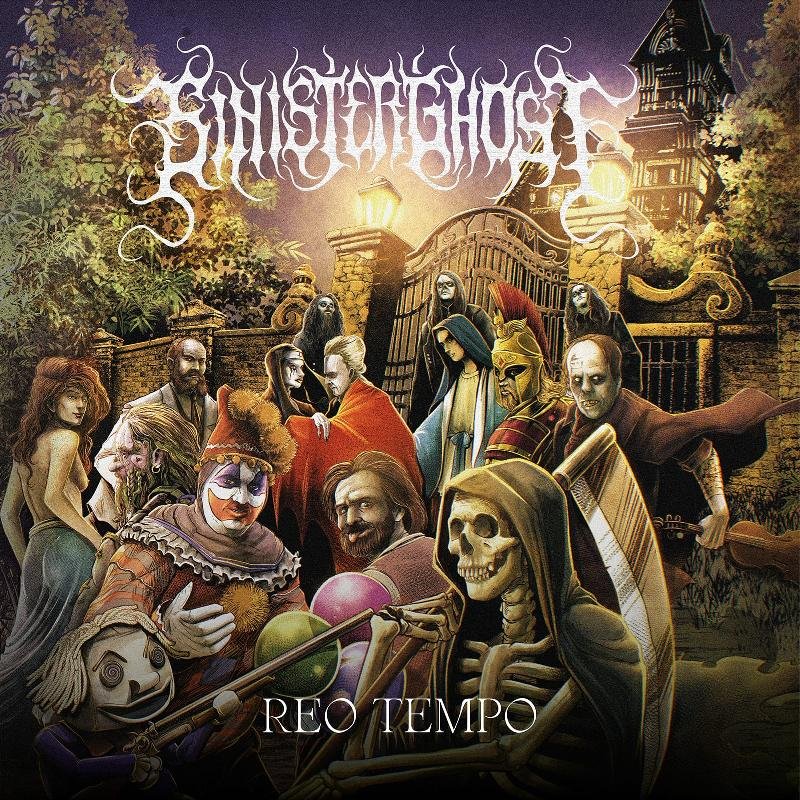
Who is God today? Man? Money? The power that comes with wealth? These are the questions at the heart of Who Is God Now?, a track by Sinister Ghost from their latest EP, Reo Tempo. Much like Kill That Fetus: The Anti-Life Manifesto, the song has a visual counterpart in the form of a music video.

And when the Viareggio-based band decide to bring the meaning behind their songs to the screen, it is never a casual choice.

Production of the video began in October 2025, roughly a month before the release of Reo Tempo, based on mastermind Asmort’s idea to visually bring to life every meaning hidden in the song’s lyrics. Under his artistic direction and the direction of Andrea Sigali, the video does not simply accompany the track with a succession of images. Instead, it creates an entire visual universe in which every element conveys not only the essence of the song itself, but also that of the record as a whole, built around the central idea of anti-conformism.

The Television Show: A Nightmare Comes to Life

Designed to recreate a surreal television program, the music video takes the question contained in its title. It places it directly at the centre of the screen, turning it into a provocation aimed at the viewer: “Would you slap God for some money?”

The question is posed by Synugoth, the band’s guitarist, who serves as a television host, addressing both the studio audience and viewers at home. From that moment on, what might initially appear to be an ordinary television show gradually turns into a manifestation of everything Sinister Ghost explicitly explores in their lyrics. And the scenes that follow leave little room for doubt.

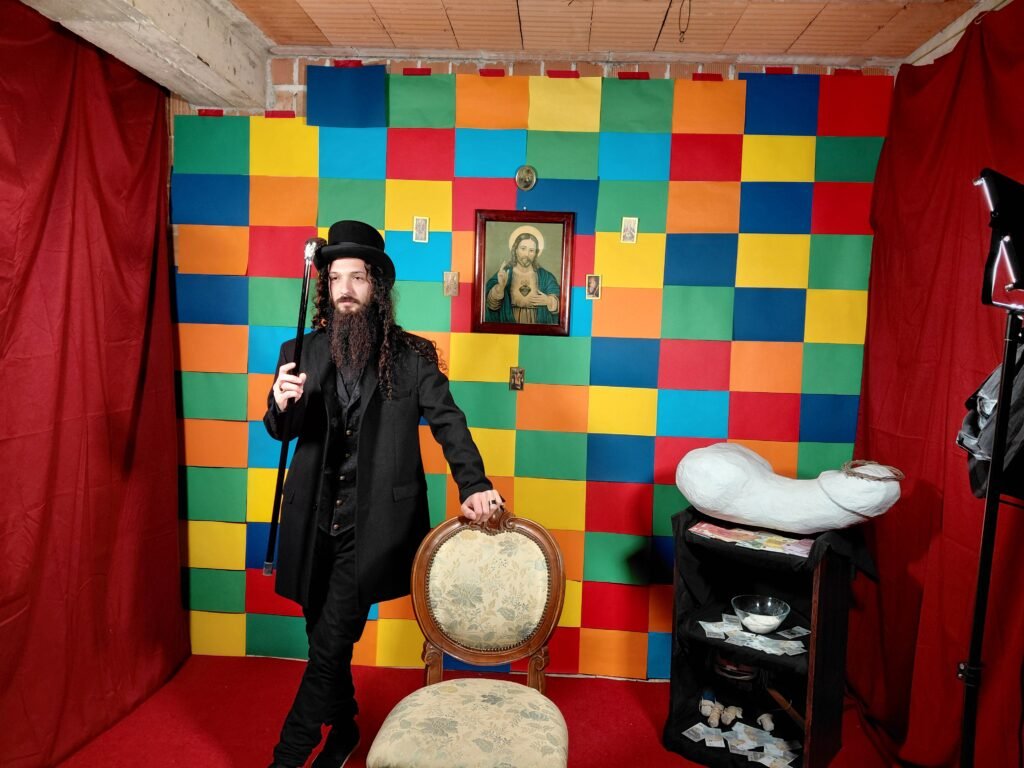
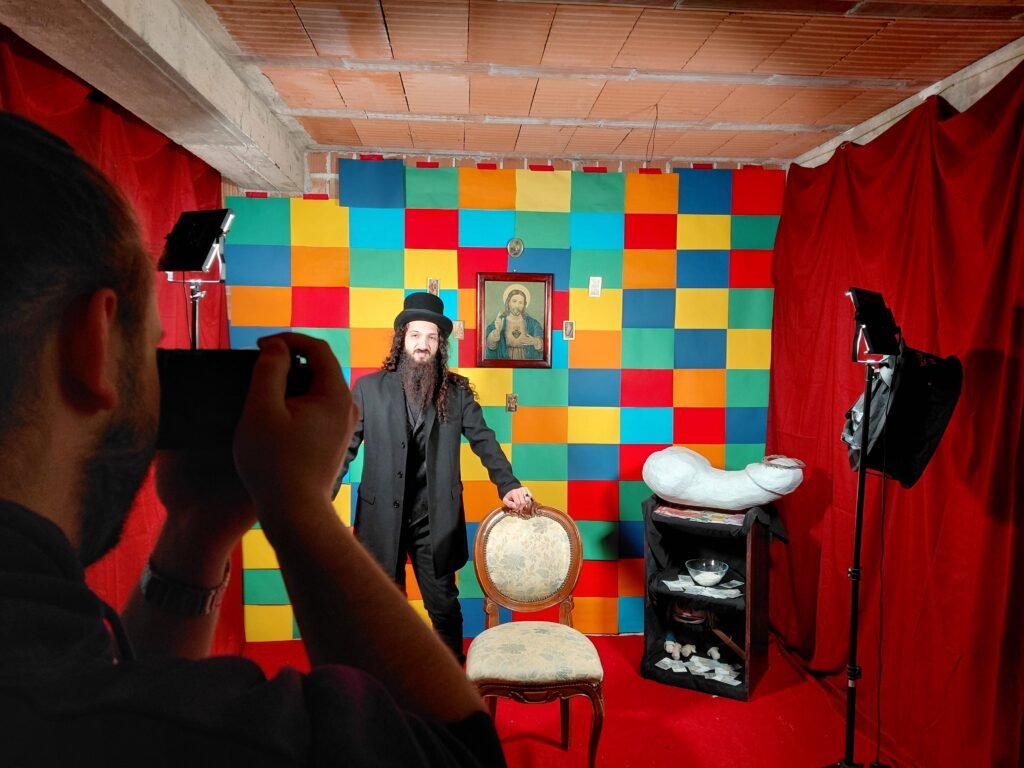
The set of the videoclip with Synugoth in the centre

The television studio is the first major building block of this universe. The red curtains on either side were chosen as a tribute to Stanley Kubrick, with a particular nod to the atmosphere of The Shining. Asmort and Synugoth painstakingly covered the wall behind the protagonists with coloured sheets of the same rectangular shape to recreate the look of an old-school television set.

The aesthetic is deliberately artificial, almost theatrical. It feels as though we are watching a television broadcast from another era, yet the imagery immediately suggests that something far more disturbing is hiding behind this seemingly harmless spectacle.

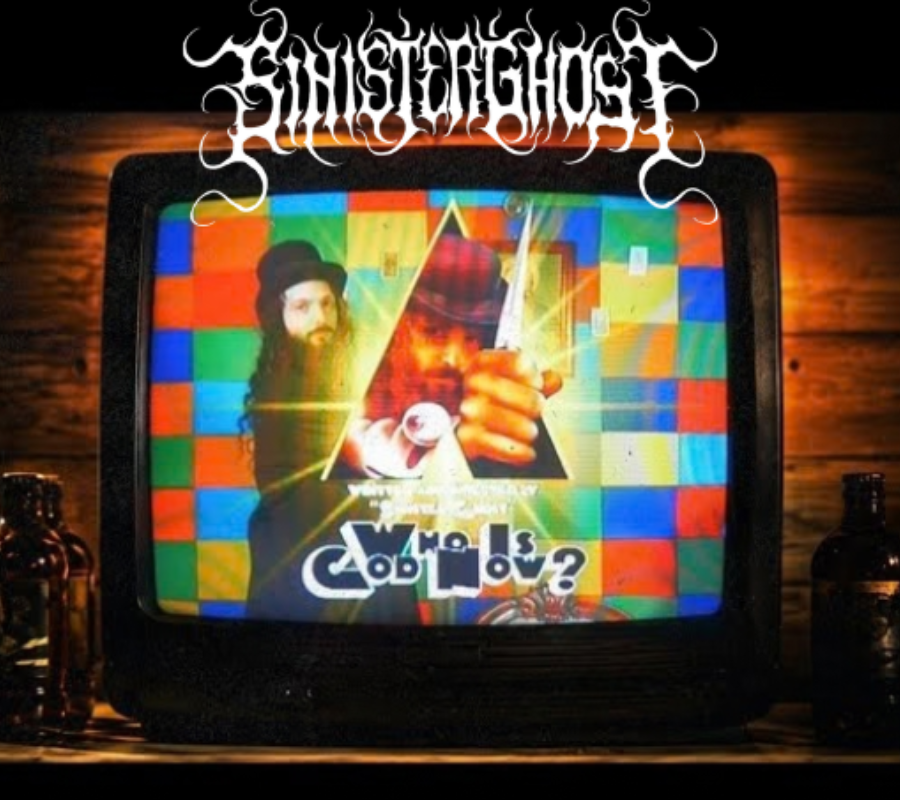
References to A Clockwork Orange make this choice even more explicit. The white phallic statue featured in the set is a direct tribute to Kubrick’s film, as is the television show’s logo — nothing more than the title of the song itself — with Alex DeLarge replaced by Synugoth.

The video therefore builds its visual language through a series of references and contrasts: vintage television and cinema, religion and money, spectacle and violence.

The Metaphor of Consumerism

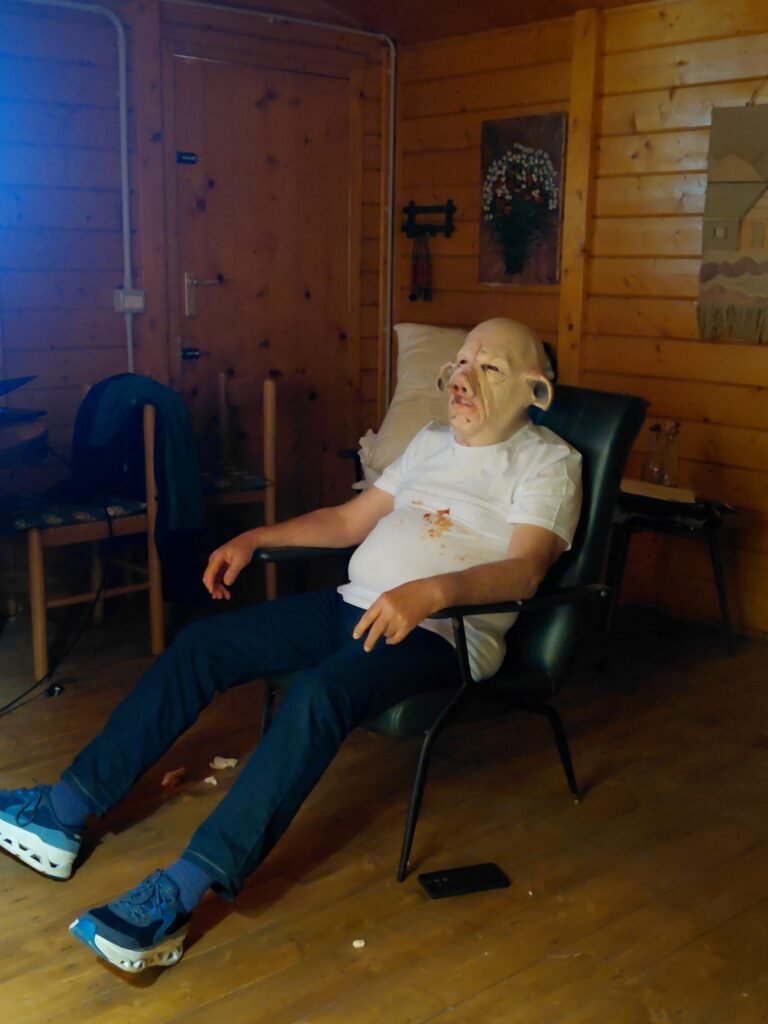
In the opening scenes, set inside a mountain cabin, we encounter the pig, a representation of consumerism and the greed of modern man. It devours a sandwich with exaggerated voracity, without even taking the time to taste it, leaving pieces of food scattered across its clothes. The scene is grotesque precisely because it turns an abstract concept — compulsive consumption — into a physical, almost animalistic behaviour.

The spectator character wearing the pig mask.

A crucifix hangs above the old-fashioned television set. The religious symbol is therefore placed directly within the same space occupied by consumption and televised entertainment. The contrast becomes even more striking when the character enthusiastically responds to the host’s provocation, applauding frantically.

It is one of the first moments when the video suggests that the question posed by the title is not simply about God in a religious sense, but may also concern whatever in contemporary society has come to occupy the place once reserved for the sacred.

And what if that place has been taken by money?

How Much Is Morality Worth?

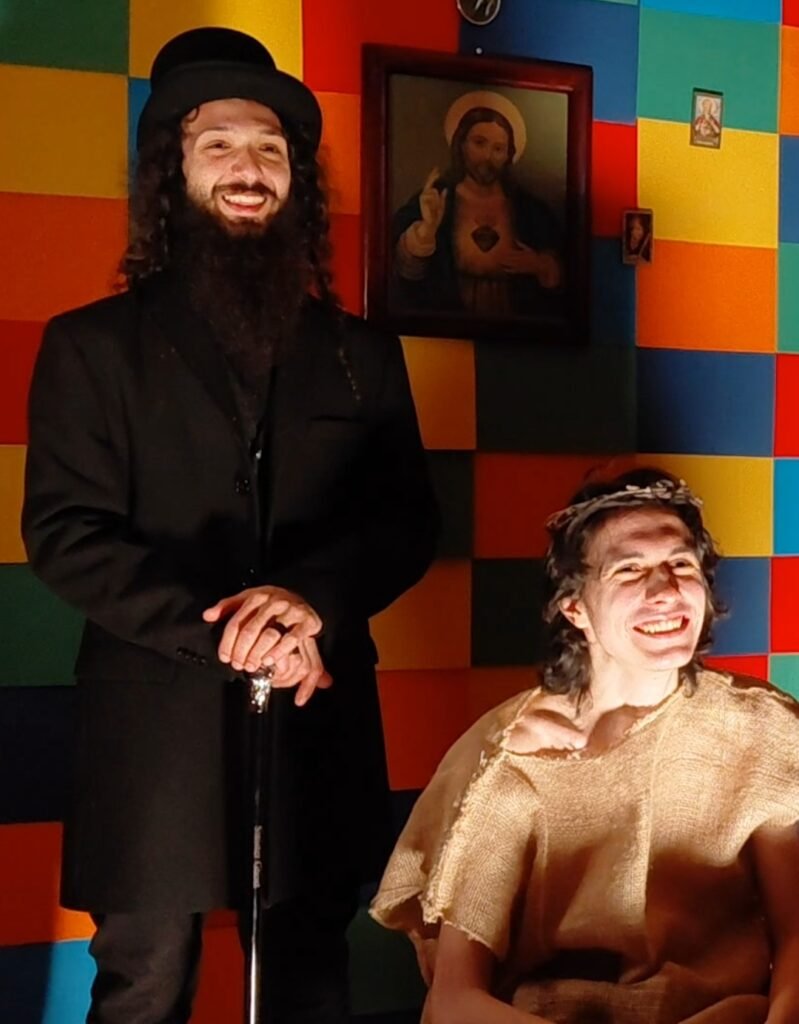
The host’s question consequently becomes the central focus of the entire video. Christ, portrayed by Pakxoid, is the victim around whom the spectacle is built. The crown of thorns, specially made by Synugoth and Nicole Stagi, is placed on his head before he is subjected to a series of very real slaps. The blows are delivered by Asmort, Aelodh and Andrea Sigali, who deliberately add flour to the scene to create a more striking effect in the footage, particularly during the slow-motion shots.

Violence is thus turned into spectacle. A person’s suffering becomes entertainment, while money becomes a possible justification for the act.

And this is where the video poses its most uncomfortable question: how much must a reward be worth before we are willing to set aside what we believe in?

The Victim Becomes the Executioner

The most compelling answer comes in the cornfield.

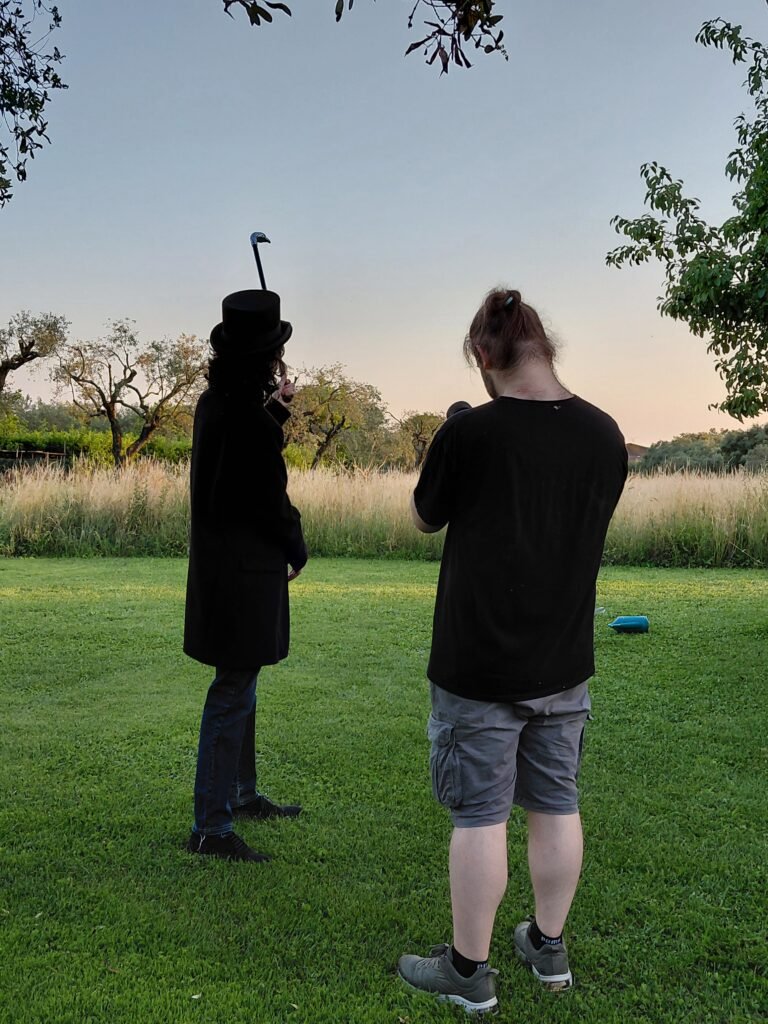
The scene was not part of the original concept and was introduced later to complete the video’s vision. Asmort conceived it as a kind of dream sequence in which the victim, through money, acquires the same power as the executioner and ultimately becomes exactly what he had previously suffered at the hands of the executioner.

The filming of the cornfield scene.

The transition is crucial because it shifts the focus from the simple relationship between money and violence to the relationship between money, power and transformation. Money does not simply compensate the victim: it allows them to take the place of the executioner.

The sequence also evokes Carlo Collodi’s Pinocchio, particularly the episode in which the Fox and the Cat convince Pinocchio to bury his coins in the ground, promising him a tree that will grow rich with money. In the music video, however, the tree actually grows.

What is a deception in Pinocchio becomes reality here. The desire for wealth is fulfilled, but its fulfilment does not lead to liberation. Instead, it leads to the reproduction of the same violence.

When Spectacle Becomes Violence

The television set gradually becomes a place where anything can be transformed into entertainment.

One of the most complex shots is the moment when the host strikes Christ in the face from above using the white phallic statue from the set, echoing A Clockwork Orange and the famous scene in which Alex DeLarge kills the Cat Lady. The shot was achieved by placing the camera on the floor and pointing it upwards, with a spotlight positioned alongside it to create the required lighting effect.

Some of the video’s most striking elements also emerged spontaneously on set. The scene in which Synugoth strikes the portrait of Christ with a stick, shattering the glass, was not included in the original script. The same applies to the blood that emerges from Christ’s mouth.

Both sequences were captured in a single take, helping to make the music video more than a straightforward visual translation of the song. They become part of an autonomous visual language, constructed through symbols, references, allusions and provocation.

So, Who Is Our God?

In the end, the title Who Is God Now? comes to weigh heavily over the entire video.

The opening question is never given a definitive answer. Instead, it is repeated through increasingly extreme images: the crucifix beside the television, consumerism embodied by the pig, Christ transformed into a victim of spectacle, money allowing the victim to become the executioner, and the tree finally growing from the buried coins.

A full view of the set.

The Sinister Ghost video therefore seems to construct a parable about the power of money and the ability of spectacle to turn even violence into entertainment. And perhaps the real point is not simply to ask who God is today.

Perhaps the more disturbing question is this:

What are we willing to sacrifice when money becomes our God?

Related articles

Leave a Reply

Your email address will not be published. Required fields are marked *

Share